Method
Sort the problems. Design them out. Turn the rest into revenue.
Most organisations fix whatever is loudest. I sort everything by what it could cost you, build the system that stops it coming back, and then point that system at the work and money it uncovers.
Part one: the funnel
Every problem on one page, fixed in order
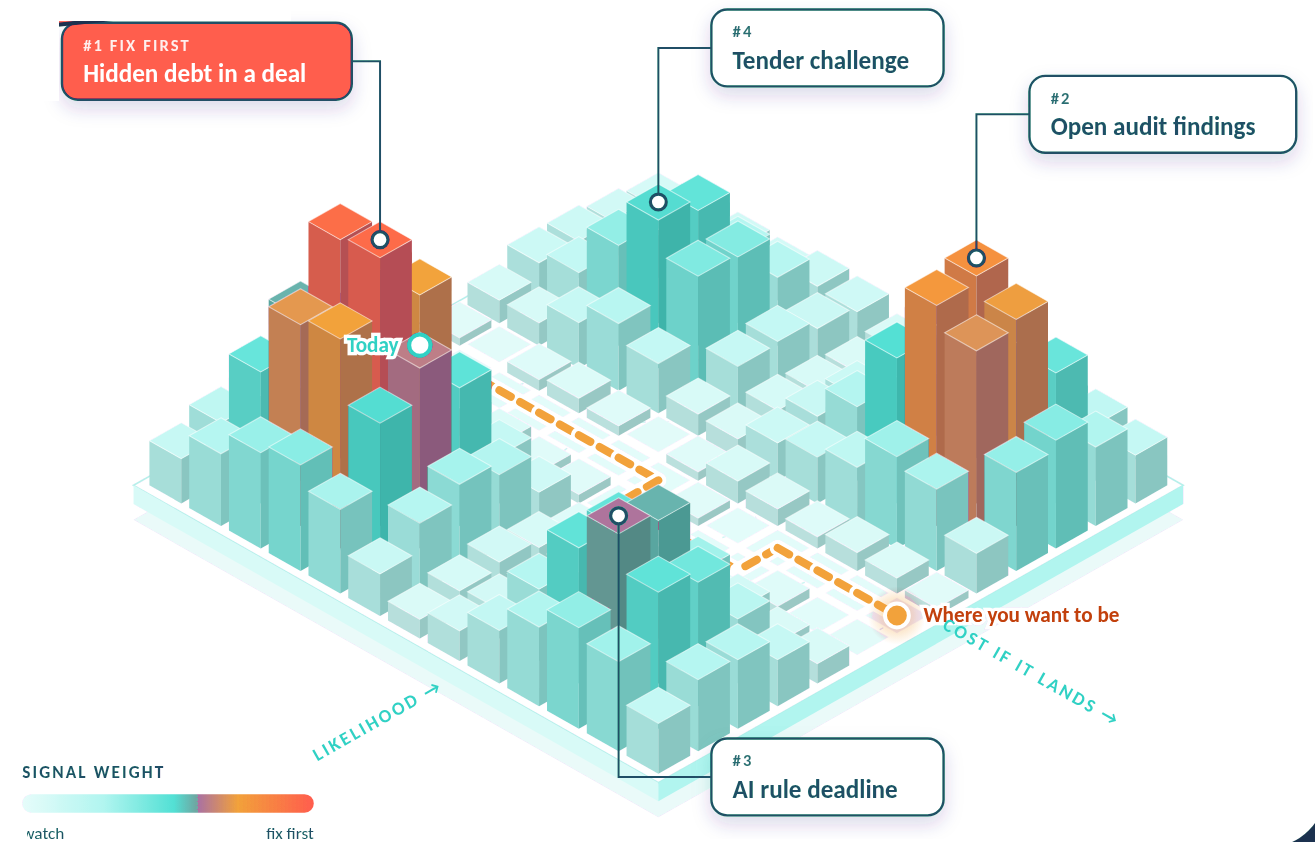
I built the first version at Arivia.kom to pull a whole group's problems into one view for the board. The turnaround ran on it. AI Compliance Radar works the same way today.
- 1Pull every signal inAudit findings, legal matters, staff turnover, procurement breaches, card overspend, customer complaints, and now the AI rules.
- 2Give each one a weightWhat it could cost you, and how soon.
- 3One owner, one dateNot a committee. One name, one date, checked every month.
- 4Report one page until it is clearThe board sees the same view every time, so they can watch it move.
Part two: preventive design
Draw the system before anyone runs it
A lawyer trained in preventive law asks what will go wrong before it does. I map every phase, owner and check on one page, then walk the board through it until the weak joints show. Fixing a box on a diagram costs nothing. Fixing it after a tender complaint or an audit finding costs a lot.
- OneSKY tender evaluation. Five phases, each with its own report and approval gate, drawn in Visio so the evaluation board could see the whole process on one page.
- Every tender document tracked. Each document in the tender pack had an issue sheet behind it, and a timeline showed what had to be ready, and when, before release.
- Supplier relationships that report both ways. My SPACE model (strategy, planning, analysis, cooperation, evaluation) let Airservices and its key suppliers measure each other.
Part three: problems into opportunity
The same map shows where the money is
A problem you spot before your client does is a reason for them to buy from you. Once the system runs inside, I point it outward.
- Problems found at clients. At Arivia.kom I ran the funnel over our clients' environments too, including Transnet (South Africa's state freight company) and Eskom (its state power utility). What it found turned into new work for us.
- The dashboard became a product. The risk and management dashboard I built for the executive was later offered to customers.
Why me
What you get that others miss
Lawyer, auditor and buyer in one person
The contract, the control and the tender get read together, so the gaps between them show up.
Done at scale
A 1,500-person technology group, and a civil and Defence air traffic programme later contracted at A$1.22 billion (about USD 910 million).
I build the tools myself
The funnel behind the Arivia.kom turnaround, AI Compliance Radar, and the AI agents that run my own practice.
You deal with me
From the first read to the final report.